
Benefits of Laboratory Management Software in India
The diagnostics industry in India is one of the fastest growing industries in India, projected to be worth ₹1.1 lakh crore by 2030. However, many labs, ranging from standalone Tier-2 facilities to multi-branch chains in metros, continue to use manual, paper-based workflows that are inherently error-prone, time-consuming and simply incapable of handling the volume of data that is required in today's healthcare environment.
In India, the benefits of laboratory management software are not debatable these days. The need for a comprehensive Laboratory Management System (LMS) has become essential for labs that are increasingly focused on delivering timely results, ensuring compliance, lowering expenses, and enhancing patient experience.
Healthion has worked with hundreds of labs in India all over the country. This is an LMS guide that explains everything about the reasons why LMS is truly changing the diagnostics landscape in India.
What Is Laboratory Management Software?
Laboratory Management Software (LMS), also referred to as Laboratory Information Management System (LIMS), is an electronic system that automates and manages all of the work within a laboratory, ranging from patient registration and sample collection to processing tests, generating results, processing billing, and analytics. It replaces manual registers, spreadsheets, and disjointed tools with one, all-in-one system that ensures all departments are connected, accountable, and efficient.
In the case of Indian labs, which may experience significant fluctuations in patient numbers from day to day and where accuracy can literally mean the difference between life and death, an LMS is more than just a software acquisition; it's an investment in quality, reputation, and future expansion.
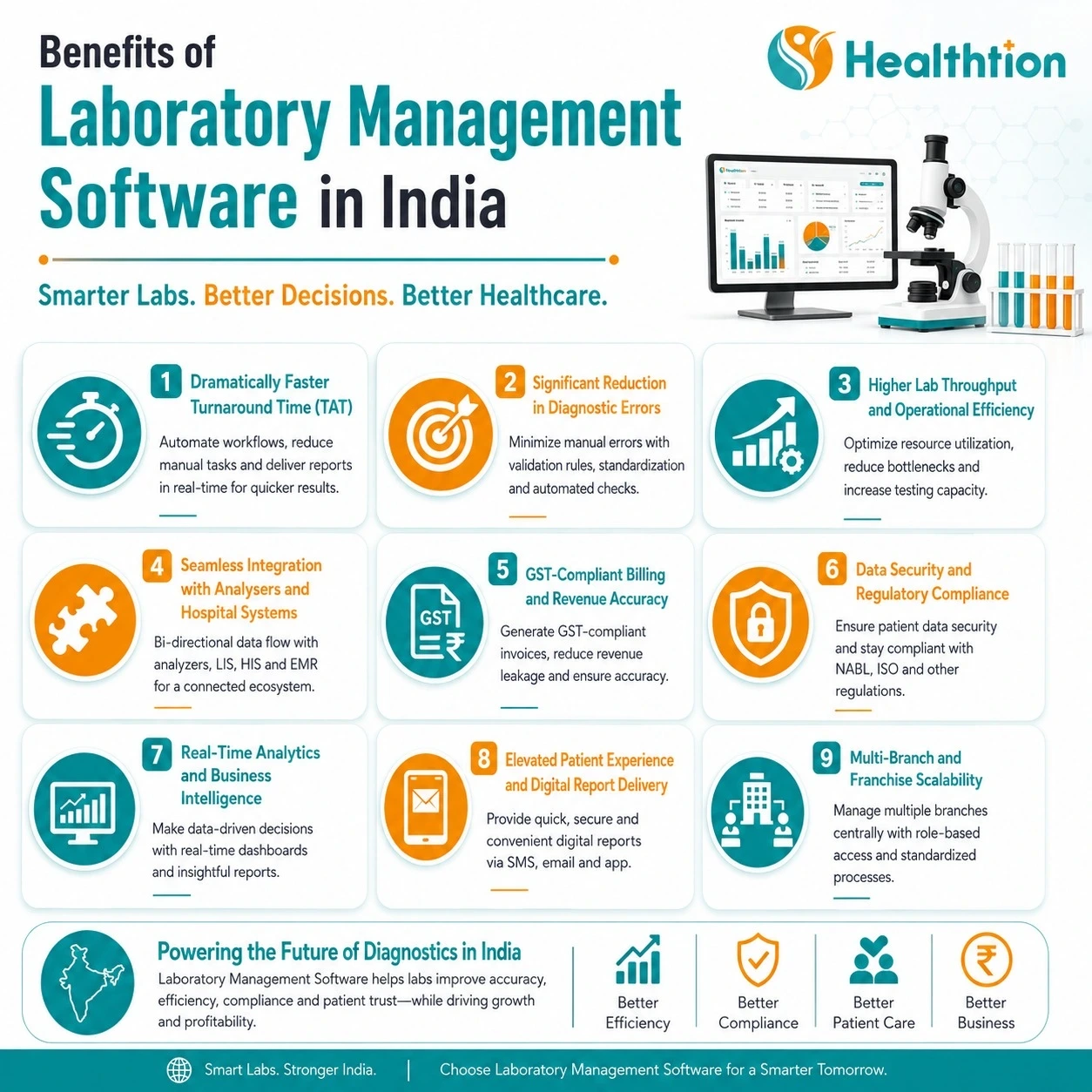
1. Dramatically Faster Turnaround Time (TAT)
In diagnostics, quickness is the key. This delays reports, which can be frustrating to patients and referring doctors, and in a competitive market, slow labs lose business to faster labs. Reducing the turnaround time for tests is one of the apparent and immediate advantages of laboratory management software in India.
From sample collection to processing to reporting results, LMS handles all the steps of the sample journey. Automated alerts alert the laboratory staff when a sample comes in or when a test is finished. When results are outside of normal ranges, critical value notifications are triggered immediately. With integration, results move seamlessly into the system without having to manually type them in, significantly reducing processing time.
This speed advantage directly correlates to increased capacity, doctor relationships, and revenue for high-volume labs with hundreds of samples and tests processed per day.
2. Significant Reduction in Diagnostic Errors
One of the greatest threats in path is human error in manual data entry. The consequences of misread handwriting, incorrect ID mapping, and transcription errors extend past operational hassles to potentially wrong diagnoses.
The benefits of laboratory management software in India in this regard are quite prominent. Barcode sample tracking guarantees that each sample is correctly associated to the proper patient at sample collection time. Auto-import from analysers eliminates the entry of results completely. Duplicate sample flags with the possibility of sample mixing before it becomes an issue. Result validation workflows (delta checks) compare new results with the old ones and alert any discrepancies in the results that may appear abnormal or inconsistent before results are sent to the patient.
It's a multi-layered error prevention system that will change the nature of diagnostic reporting forever.
3. Higher Lab Throughput and Operational Efficiency
Efficiency is key to a successful lab, LMS removes all those hidden productivity leaks in the workflow; the front desk registers more quickly and efficiently, samples are collected, processed, quality checked and reported on speed, smoothly, and consistently.
This frees up staff time to attend more important activities, such as patient care, quality control, and business development. Automated billing is the generation of an invoice at the time of service, instead of being batched and sent at the end of the day. Multi-parameter profiles generate reports much faster than in the past. In this aspect, the advantages of lab management software in India provide tangible returns to growing Indian labs in no time, and this is where they will be able to scale without scaling the staff proportionately.
4. Seamless Integration with Analysers and Hospital Systems
A stand-alone system is as good as its communication ability with other systems. An integrated ecosystem of modern LMS platforms can seamlessly connect with diagnostic equipment, Hospital Management Systems (HMS), Electronic Health Records (EHR), and billing systems, eliminating duplicate data entry and ensuring seamless flow between systems.
The support for industry standard protocols such as HL7 and FHIR will enable compatibility with hospital IT systems. Bidirectional analyzer interfaces to top equipment brands allow the results to flow from the machine to report without the need for human intervention. Compliance with the Ayushman Bharat Digital Mission (ABDM) framework enables Indian labs to seamlessly integrate patient health records with health IDs, which are becoming increasingly common as the national health stack advances in India.
This degree of integration is effective in preventing data silos, in reducing duplication and generation of a single source of truth in the entire diagnostic delivery chain, which is one of the reasons why the benefits of laboratory management software in India are not limited to the lab only and extend to the entire healthcare delivery chain.
5. GST-Compliant Billing and Revenue Accuracy
Silent killers in Indian labs are billing errors and revenue leakages. Direct losses from incorrectly billed tests, incorrectly applied discounts, packages misconfigured, and unbilled add-ons, are all examples of issues that result in financial loss, and which can often go unidentified by lab owners.
This is fully addressed by the LMS. All tests ordered are automatically associated with an invoice. Discounts must be approved by the authorised persons before they are awarded. The invoicing is auto generated at the time of billing, and is compliant with GST and correctly classified, with no compliance risks whatsoever. Disputes with referring doctors are avoided as referral commission tracking, and the report of amounts paid are automated. The excellent and credit management capabilities enable collections teams to pursue a systematic approach, shorten the revenue cycle, and enhance cash flow.
Built for India's billing requirements, including GST, insurance claim formatting, and financial workflows specific to the diagnostic lab industry in India, Healthion's LMS is natively designed for them.
6. Data Security and Regulatory Compliance
Since the Digital Personal Data Protection (DPDP) Act, 2023 came into force, handling patient data is now a legal requirement for all healthcare institutions in India, including diagnostic labs. At the same time, labs applying for NABL accreditation or ISO 15189 certification must have documented and auditable processes for quality management – something that would be impossible to achieve using paper-based systems.
A robust LMS will tackle all these requirements head on. With a role-based access control, only authorised users have access to view or edit sensitive patient information. Each login, edit and data access operation is captured in a comprehensive audit trail which meets the requirements for documentation that regulators and accreditation bodies in demand. Patient information is kept safe from breaches by encrypted data storage and secure data transmission. Automated cloud backup means data is backed up even if something happens with the local hardware.
With the government's growing regulatory oversight of the diagnostics industry, the advantages of laboratory management software in India have become a non-negotiable.
7. Real-Time Analytics and Business Intelligence
It's like running a business without data. LMS platforms offer instant dashboards and reports that allow lab owners and managers to see the big picture of their operation (financial, operational, and clinical).
Targets are tracked daily, doctor performance reports are made available, equipment utilisation is summarized, report ageing alerts are made available and TAT compliance are tracked at a single glance. This type of visibility enables lab owners to make better choices, optimize pricing strategies, better manage their reagent supply chain, schedule their staff properly, and determine which tests or referral partners are bringing the most value.
This information can be a competitive advantage over time for labs, enabling them to spot trends, predict demand, and make strategic investments with confidence.
8. Elevated Patient Experience and Digital Report Delivery
Patients today are tech-savvy and expect a similar seamless experience when they go to diagnostic laboratories, as they do when visiting their bank or an online shopping site. One of the most customer-friendly benefits of laboratory management software in India is its ability to meet their expectations.
LMS allows for results to be sent through WhatsApp and SMS in minutes after the results are validated. Patient self-service portals enable patients to download previous reports, check the status of their orders, and make payments online without having to go to the laboratory. An even easier experience is provided with home collection modules and phlebotomist scheduling and tracking. Digital feedback and NPS scores enable labs to have a constant view of patient satisfaction and care issues and address them before they harm the lab's reputation.
A smooth digital journey is a valuable competitive edge in a world where word-of-mouth and online reviews have become a key patient selection criterion.
9. Multi-Branch and Franchise Scalability
India's diagnostics market is undergoing rapid consolidation. From metros to tier-2 and tier-3 cities, regional chains and franchise models are growing at a pace that manual systems can’t keep up with. One of the most crucial benefits of laboratory management software in India for aspiring laboratory enterprises is the ability to run multiple branches from a single central location.
Centralized master configuration enables test menus, pricing and packages to be centrally controlled from headquarters and disseminated to all the branches at once. The inter-branch sample referral tracking guarantees that samples being gathered from one location and processed at a hub lab are tracked without losing sight of the process. Full operational control with consolidated MIS reports as needed across all branches. Cloud-native architecture is reliable for keeping all branches in sync, even with the lower bandwidth internet that is frequently available in smaller cities.
Also know: How Laboratory Management Software Reduces Human Errors in Indian Labs?
Why Healthion Is the Right LMS Partner for Indian Labs
Most LMSs that are globally available are designed for western healthcare workflows and awkwardly adapted to be used in India. Unlike the rest, Healthion is specifically designed for the actual Indian diagnostics reality and understands the challenges that are faced by Indian labs.
Regional language support for patient communication in Hindi, Telugu, Tamil, Marathi, Bengali and others, makes it possible for labs to cater to patients in their native language. Specific on-ground implementation and support teams ensure that labs are up and running in no time and are provided with timely support when needed.
Healthion's LMS is built to grow with your vision, whether you're working out of just one room of a pathology office or a multi-city diagnostic chain.
Conclusion
Laboratory management software offers numerous advantages in India, all of which have tangible implications for patient safety, operational efficiency, regulatory compliance, and business growth. The diagnostics industry in India is growing rapidly to fulfil its vast potential and the labs that invest in smart technology solutions today will be the ones to lead the market tomorrow.
The days of manual processes are over. Detection and diagnosis are a digital, connected and data-driven future in India.
Looking to feel the Healthion difference? Talk to us today and see how our LMS can change your lab!